




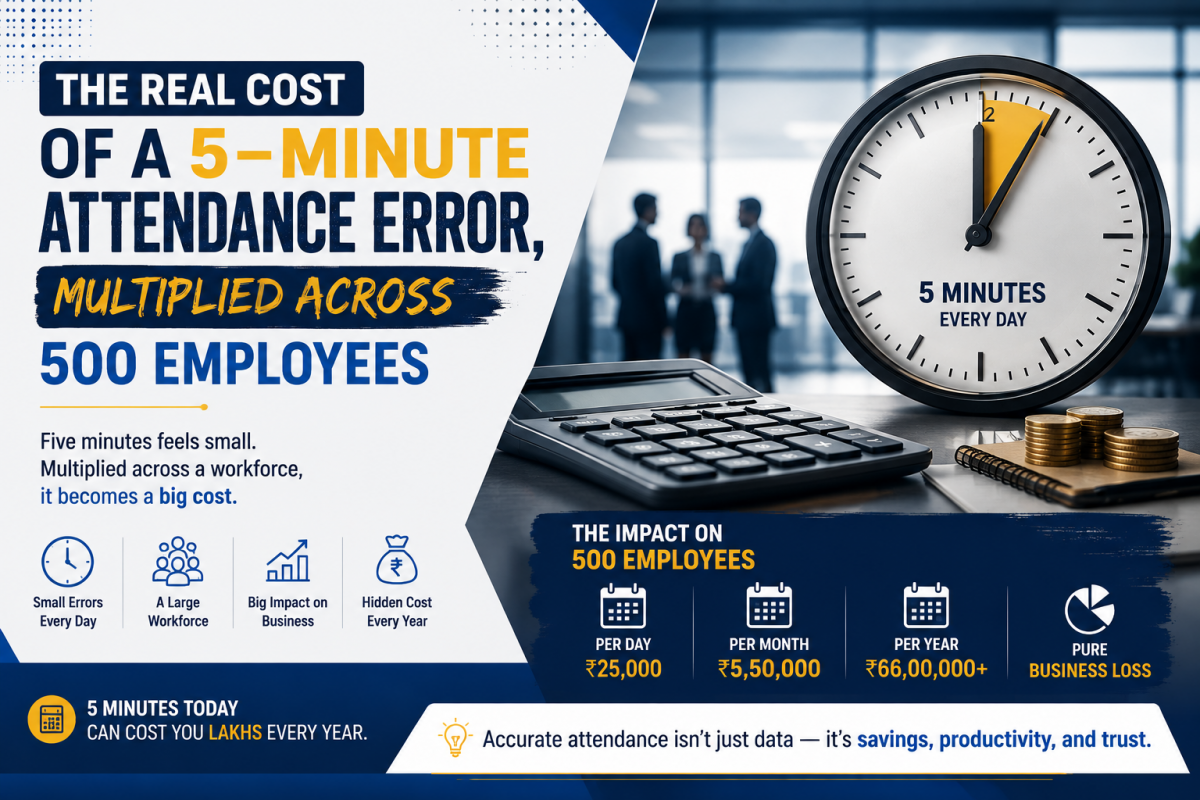
The Real Cost of a 5-Minute Attendance Error, Multiplied Across 500 Employees
Five minutes feels negligible. Multiplied across a workforce, every single day, it stops being a rounding error and starts being a line item.
If you asked a manager whether a 5-minute attendance discrepancy matters, most would shrug. Someone clocks in a few minutes late, someone else's entry gets rounded generously, a supervisor eyeballs a register and marks "present" without checking the exact time. None of it feels like a problem in isolation.
But attendance errors don't happen in isolation. They happen every day, across every employee, compounding quietly in the background until they show up as a number nobody can quite explain on the payroll report.
The Math Nobody Runs
Let's make this concrete with a simple example.
Assume a mid-sized company with 500 employees, an average fully-loaded cost of ₹600 per hour per employee (salary, benefits, overhead combined — this varies widely by industry, but works as an illustrative baseline), and a 5-minute average discrepancy per employee per day between actual worked hours and recorded hours.
Per employee, per day:
5 minutes = 0.083 hours × ₹600/hour ≈ ₹50 in unaccounted time
Across 500 employees, per day:
₹50 × 500 = ₹25,000 per day
Across a working month (22 days):
₹25,000 × 22 = ₹5,50,000 per month
Across a year:
₹5,50,000 × 12 = ₹66,00,000 per year
That's over ₹66 lakh a year — from a discrepancy so small that no individual manager would ever flag it. And this is a conservative estimate: it assumes the error runs in only one direction and doesn't account for overtime miscalculations, which tend to compound the problem further.
Where the 5 Minutes Actually Comes From
This isn't a hypothetical rounding error — it's the sum of very real, very common gaps in manual and semi-manual attendance processes:
Rounding generosity.Registers and basic biometric systems often round to the nearest 5 or 10-minute block. An employee arriving at 9:07 gets marked as 9:00. Multiply that across hundreds of people, every day, and the rounding stops being neutral.
Buddy punching and proxy marking. A colleague marks attendance for someone running late, "just this once" — except it happens more than once, and it's rarely caught.
Delayed or batch entry. Attendance recorded at the end of the day from memory, rather than in real time, introduces systematic inaccuracy that skews toward the employee's benefit (deliberately or not).
Break time leakage.Extended breaks that aren't tracked precisely — a 20-minute break logged as 15, repeated daily, across a large workforce.
System downtime workarounds. When biometric devices fail or queues form during peak clock-in times, manual overrides get used "temporarily" — and temporarily often becomes permanently.
Why This Stays Invisible for So Long
The reason this cost goes unnoticed isn't that it's small — it's that it's distributed. A ₹66 lakh annual leak sounds alarming as a single number, but nobody experiences it as a single event. It arrives in fragments of a few rupees per person per day, absorbed into payroll without triggering any alarm, because no single discrepancy is large enough to investigate on its own.
This is precisely why manual and semi-automated systems are so vulnerable to this kind of loss — the errors are individually too small to notice, but structurally guaranteed to recur, every single day, for every single employee.
It's Not Just About Money
The financial cost is the easiest to calculate, but it's not the only cost :
- Payroll disputes increase when employees notice discrepancies between what they believe they worked and what's recorded, damaging trust in HR processes.
- Compliance risk grows when attendance records don't align with statutory requirements for minimum wage, overtime, or working-hour regulations — a gap that becomes a liability during labour audits.
- Decision-making gets distorted. Workforce planning, staffing decisions, and productivity analysis are all built on attendance data. If that data carries a systematic bias, every downstream decision inherits the same error.
Precision at Scale Isn't a Luxury
The common objection to fixing this is that 5 minutes simply isn't worth the effort to chase. And for a team of five people, that might even be true — the total exposure is trivial.
But the entire nature of the problem changes with scale. What's negligible at 5 employees becomes a six-figure or seven-figure annual cost at 500. The larger the workforce, the more a small, systematic inaccuracy compounds into something that genuinely affects the bottom line — which is exactly why organisations with large or multi-location teams are the ones who stand to benefit most from tightening attendance precision, down to the second rather than the nearest rounded block.
The Takeaway
A 5-minute error feels too small to matter. That feeling is exactly what allows it to persist, unexamined, for years. The organisations that catch this aren't the ones with the most vigilant managers — they're the ones whose systems don't allow the error to exist in the first place, because attendance is captured precisely and automatically, the moment it happens, rather than estimated, rounded, or reconstructed after the fact.
Run the math for your own team: take your average hourly cost per employee, multiply by even a few minutes of daily discrepancy, and multiply that across your full headcount. The number that comes out is usually a lot bigger than anyone expects it to be.




Comments
Loading comments...