


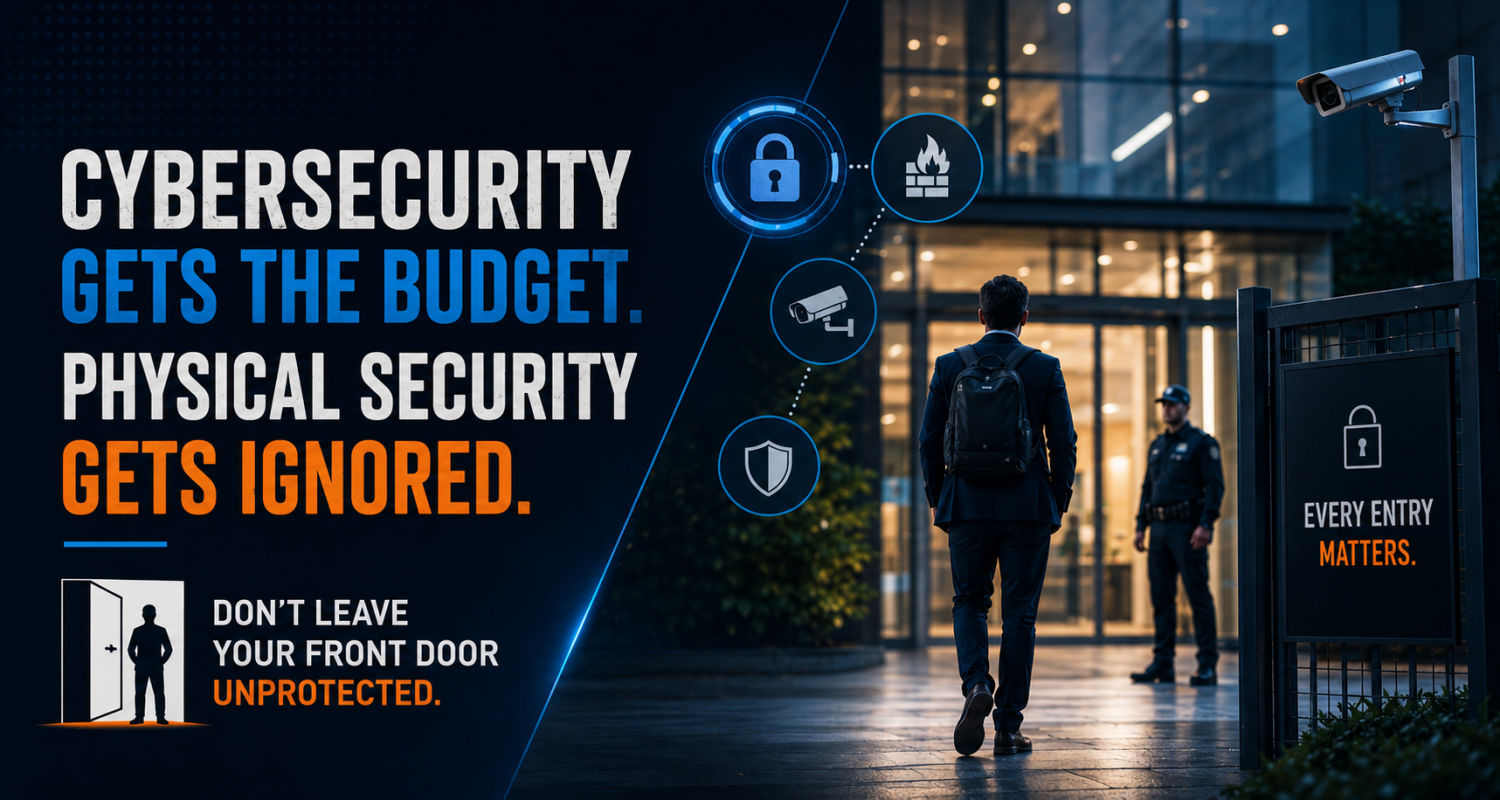
A breach doesn't always start with a hacked password — sometimes it starts with someone simply walking in. Exploring the overlooked economics of physical security investment.
Walk into any boardroom budget meeting and you'll hear the same conversation on repeat: firewalls, endpoint detection, VPNs, penetration testing, SOC analysts. Cybersecurity has become the default answer to "are we secure?" And for good reason the headlines are full of ransomware attacks, data leaks, and phishing scams that cost companies millions.
But ask the same room a different question: "Who walked through our front gate yesterday?"
Silence.
That silence is the problem.
The Budget Imbalance Nobody Talks About
Global spending on cybersecurity has grown into the hundreds of billions annually. Physical security guards, gates, visitor logs is often treated as a fixed cost, not a strategic investment. It gets a line item, not a strategy. A guard, a register, a boom barrier, and the box is considered checked.
The irony is that physical access is often the easier target. A hacker needs skill, time, and a bit of luck to breach a well-defended network. Someone walking in through an unmonitored gate, tailgating an employee through a door, or posing as a delivery agent needs none of that just confidence and a plausible excuse.
Why Physical Security Keeps Losing the Budget Battle
There are a few reasons this gap persists, and none of them hold up well under scrutiny:
1. It "feels" solved. A guard at the gate and a CCTV camera overhead create a sense of security, even when neither is actually preventing anything. Cameras record incidents after they happen they rarely stop them in the moment.
2. It doesn't make headlines the same way. A data breach affecting millions of users is a story. An unauthorized person walking into a warehouse and walking out with inventory rarely makes the news but it happens constantly, and the losses add up quietly.
3. It's assumed to be a "people problem," not a "systems problem." When something goes wrong at a gate, the instinct is to blame the guard inattentive, undertrained, distracted. But this misses the point: even the best-trained guard is being asked to make instant, high-stakes decisions with incomplete information, shift after shift, with no system supporting that judgment call.
4. Physical security is fragmented across vendors and processes. Unlike cybersecurity, which has matured into integrated platforms and clear frameworks, physical access control is often a patchwork one system for visitor logs, another for CCTV, another for access cards, none of them talking to each other.
What This Actually Costs Organisations
The cost of ignoring the front door isn't hypothetical. It shows up as:
- Tailgating and unauthorized access — employees holding doors for "friendly-looking" strangers, visitors wandering into restricted areas unsupervised.
- Inventory and asset loss — from warehouses, factories, and retail spaces where entry isn't properly verified or logged.
- Insider risk after offboarding — former employees or contractors who retain physical access long after their digital credentials were revoked.
- Reputational and liability exposure — a physical security incident, especially one involving safety, can damage trust as quickly as any data breach.
- Compliance and audit failures — increasingly, regulators and accreditation bodies expect verifiable, real-time records of who accessed a facility and when not a paper register filled in from memory at the end of the day.
Cybersecurity teams talk about "attack surface." Physical security has an attack surface too — and for most organisations, it's wide open.
Rethinking the Front Door
None of this is an argument against cybersecurity investment that spending is justified and necessary. It's an argument for parity. If a company wouldn't dream of running its network without intrusion detection, why does it still run its front gate on a paper register and a guard's best guess?
The most resilient organisations are starting to treat physical access the way they treat network access: as something that needs verification, logging, real-time alerts, and accountability not just a presence.
The next major security failure at your organisation may not come from a phishing email. It may come from someone who simply walked in because nobody was really watching the door.
Physical security isn't a lesser priority than cybersecurity it's the other half of the same conversation. The organisations that recognise this first will be the ones that aren't caught off guard.



Comments
Loading comments...