



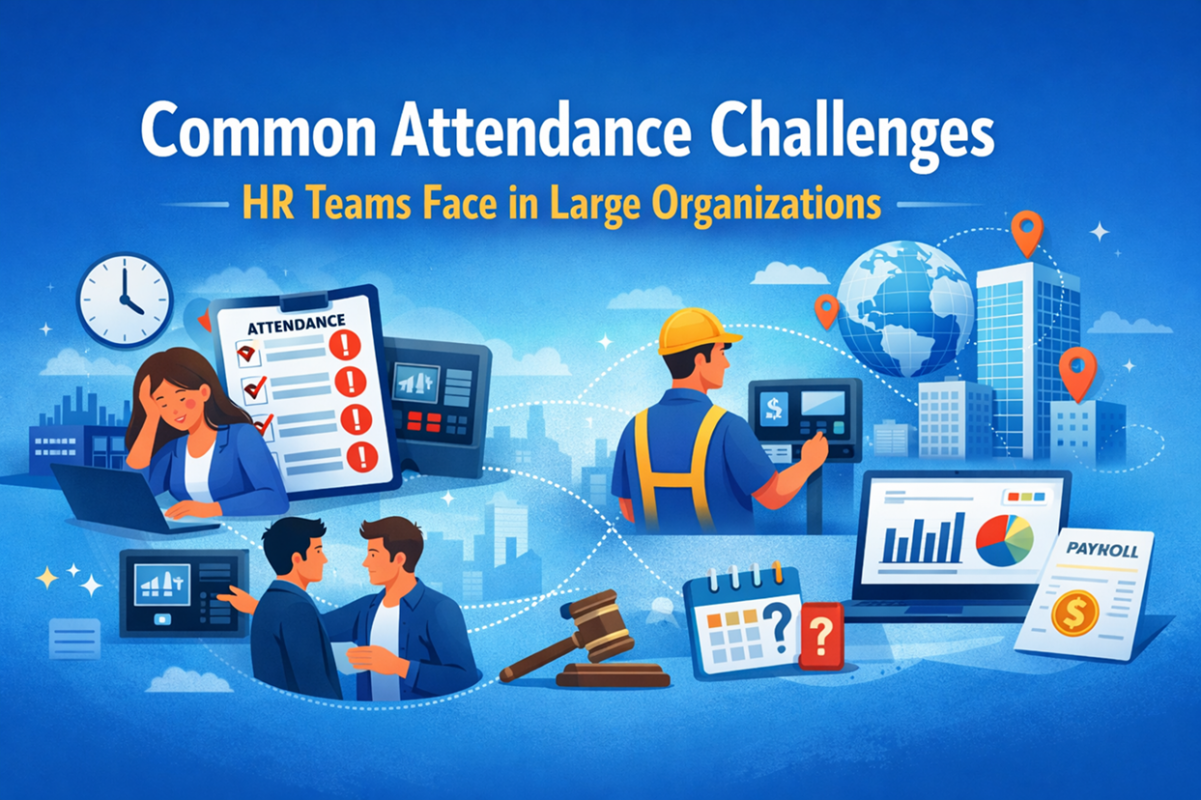
Managing employee attendance is one of the most critical responsibilities for HR teams, especially in large organizations. When companies grow to hundreds or thousands of employees across multiple departments, locations, and shifts, maintaining accurate attendance records becomes increasingly complex.
Traditional attendance tracking methods such as manual registers, spreadsheets, or standalone biometric devices often fail to meet the demands of modern workforce management. These outdated systems can lead to inaccuracies, administrative burdens, and compliance risks.
In this blog, we explore the most common attendance challenges HR teams face in large organizations and how modern technology can help address them.
1. Manual Errors in Attendance Tracking
Many organizations still rely on manual processes or partially automated systems for tracking attendance. HR teams may have to gather attendance records from multiple sources, including biometric machines, spreadsheets, access logs, or departmental reports.
This often results in:
- Data entry mistakes
- Missing or duplicate records
- Incorrect attendance calculations
Even minor errors can significantly impact payroll processing and employee records. As the workforce grows, the chances of such errors also increase, making manual systems inefficient and unreliable.
2. Buddy Punching and Time Theft
Buddy punching is one of the most common attendance issues in traditional systems. It occurs when one employee marks attendance on behalf of another employee who may be absent or late.
This practice leads to several problems, including:
- Loss of productivity
- Financial losses for the company
- Unfair workplace practices
Without proper verification methods, it becomes difficult for HR teams to detect or prevent such misuse.
3. Managing Attendance Across Multiple Locations
Large organizations often operate across multiple branches, corporate offices, factories, or campuses. Managing attendance across these different locations can be a major challenge for HR teams.
Common difficulties include:
- Lack of centralized attendance monitoring
- Delayed reporting from remote locations
- Difficulty consolidating attendance data from different systems
Without a centralized system, HR teams must spend significant time collecting and organizing attendance data from multiple sources.
4. Handling Shift-Based Workforces
Industries such as manufacturing, IT services, healthcare, logistics, and security operate with multiple shifts. Managing attendance for rotating shifts, night shifts, and flexible schedules adds another layer of complexity.
Some common challenges include:
- Incorrect shift allocation
- Missed punch-ins during shift transitions
- Confusion in overtime calculations
- Difficulty managing late arrivals or early departures
Without automated systems, handling complex shift patterns becomes extremely difficult.
5. Attendance Compliance and Labor Regulations
Organizations must follow labor laws related to employee working hours, overtime policies, and leave regulations. Maintaining accurate attendance records is essential for ensuring compliance.
HR teams must ensure:
- Accurate work-hour tracking
- Proper overtime calculations
- Documentation for regulatory requirements
Any errors in attendance data can lead to compliance issues, penalties, or legal disputes.
6. Payroll Integration Challenges
Attendance data directly affects payroll calculations. When attendance systems are not integrated with payroll software, HR teams must manually transfer attendance records into payroll systems.
This creates several risks, such as:
- Salary miscalculations
- Delayed payroll processing
- Increased administrative workload
- Employee dissatisfaction due to payroll errors
Integrating attendance systems with payroll platforms is crucial for improving efficiency and accuracy.
7. Managing Leave and Absence Records
Tracking employee leave requests, approvals, and balances becomes increasingly challenging in large organizations. Employees may apply for different types of leaves, such as sick leave, casual leave, or annual leave.
Common issues include:
- Miscommunication between managers and HR
- Errors in leave balance calculations
- Overlapping leave approvals
- Difficulty maintaining centralized leave records
A lack of transparency in leave management can also create confusion among employees.
8. Lack of Real-Time Workforce Visibility
In large organizations, HR teams and managers often lack real-time insights into workforce availability. Without real-time attendance visibility, it becomes difficult to monitor employee presence or identify staffing gaps.
This can result in:
- Inefficient workforce planning
- Difficulty identifying absenteeism patterns
- Delayed decision-making during staff shortages
Real-time attendance monitoring is essential for efficient workforce management.
9. Managing Remote and Hybrid Work Attendance
With the rise of remote and hybrid work models, traditional attendance systems have become less effective. Many systems were designed for office-based environments and struggle to track attendance for employees working remotely.
HR teams must now manage:
- Flexible work hours
- Remote employee activity tracking
- Attendance validation outside office premises
Organizations need smarter solutions that support modern work environments.
10. Limited Attendance Analytics and Reporting
Attendance data can provide valuable insights into workforce productivity, absenteeism trends, and operational efficiency. However, many traditional attendance systems lack advanced reporting capabilities.
HR leaders need access to insights such as:
- Absenteeism patterns
- Overtime trends
- Department-wise attendance performance
- Workforce productivity metrics
Without proper analytics, organizations miss opportunities to improve workforce planning and operational efficiency.
How AI-Based Attendance Systems Solve These Challenges
Modern organizations are increasingly adopting AI-powered attendance management systems to address these challenges. Advanced solutions can automate attendance tracking, improve accuracy, and provide real-time insights into workforce activity.
AI-based attendance systems offer several advantages, including:
- Automated attendance tracking
- Prevention of buddy punching through intelligent verification
- Centralized monitoring across multiple locations
- Seamless payroll integration
- Real-time workforce visibility and reporting
By automating attendance management, HR teams can significantly reduce manual work and focus on more strategic initiatives.
Smart Attendance Management with Attendify
Solutions like Attendify are transforming how organizations manage attendance. By leveraging AI technology, Attendify enables businesses to track employee attendance accurately while reducing administrative workload for HR teams.
Key benefits include:
- AI-powered attendance monitoring
- Accurate employee verification
- Centralized workforce tracking
- Real-time alerts and reporting
- Improved operational efficiency
With intelligent attendance solutions, organizations can ensure transparency, accuracy, and efficiency in workforce management.
Conclusion
Attendance management in large organizations is a complex task that involves multiple challenges, from manual errors and buddy punching to compliance issues and remote workforce tracking. Traditional attendance systems often struggle to keep up with modern workplace demands.
By adopting AI-powered attendance solutions, organizations can streamline attendance processes, improve accuracy, and gain valuable workforce insights. Modern systems not only simplify HR operations but also contribute to better productivity and organizational efficiency.


Comments
Loading comments...