

A Manager's Real Concern, Stated Honestly
When a team stops coming into an office, most managers don't actually want to know everything an employee does all day. What they want is much smaller: confirmation that the person logged in, started work, and was where they said they'd be when they did.
Somewhere along the way, "confirmation" got conflated with “tracking” and companies ended up choosing between two bad options: trust employees on their word with no record at all, or install something that monitors their location all day and makes remote work feel like being watched.
There's a third option, and it's the one that actually matches what managers need.
The Model: One Verified Moment, Not a Continuous Feed
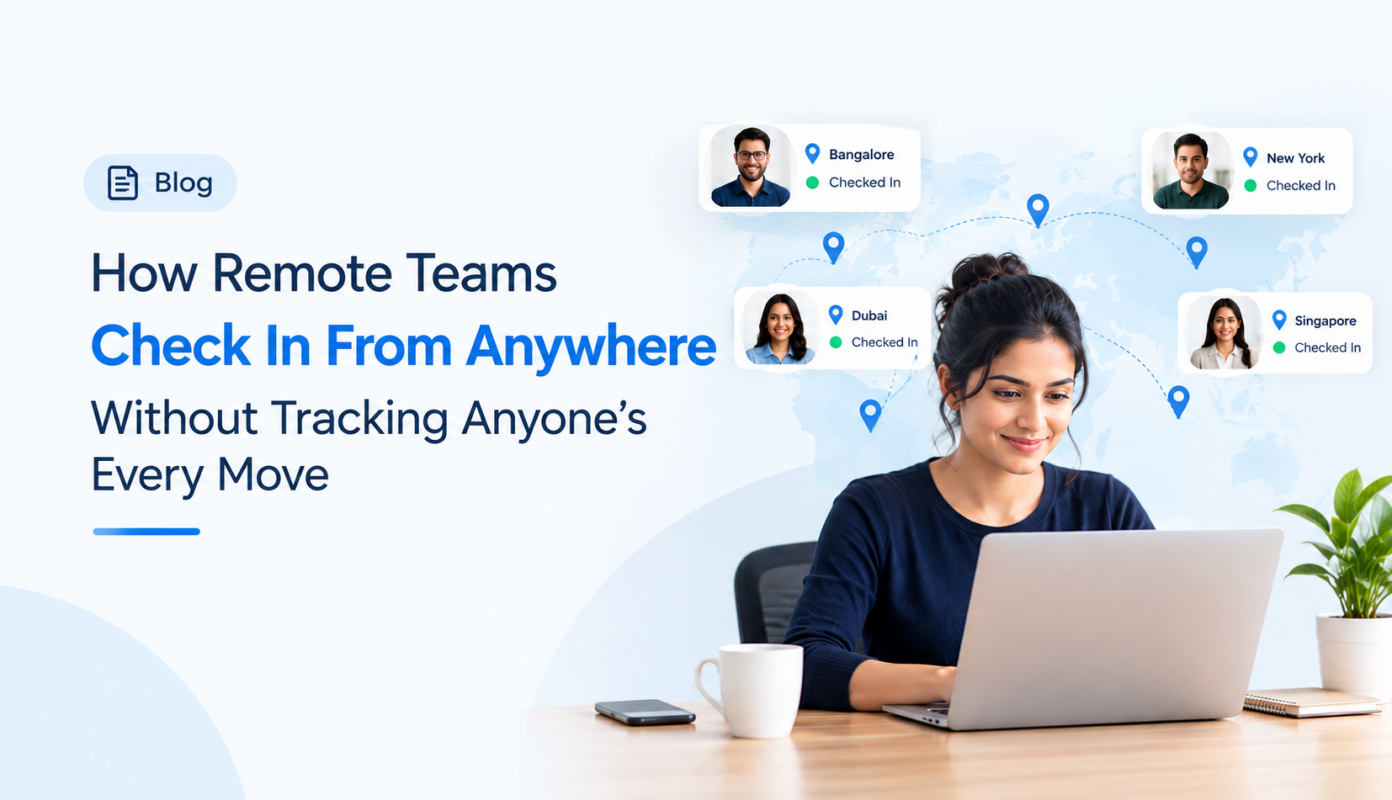
Instead of a live location feed running in the background, a mobile attendance app captures one thing, at one moment: where the employee was when they checked in.
That's it. No pings every few minutes. No route history. No record of what happens between check-in and check-out. It's the digital equivalent of an office badge reader it confirms a person was at a door at a specific time, and has nothing to say about anything before or after.
How It Works, Step by Step
1. The employee opens the app to start their shift. No separate hardware, no card, no fingerprint scanner to find just the phone they already have.
2. A quick face scan confirms who's checking in. This solves the same problem an office ID badge doesn't: a badge can be handed to a colleague, but a face can't. The system verifies the actual person, not just a logged-in account.
3. The app records the location at that exact moment. A single coordinate, tied to a single timestamp — proof of where the shift started, nothing more.
4. The record goes straight into attendance and payroll. No manager needs to manually log a remote employee's hours or take their word for a start time the verified check-in is the record.
5. At day's end, the employee checks out the same way. A second verified moment closes the loop — start and end, with nothing tracked in between.
Who This Actually Serves
Field sales reps and service engineers moving between client locations get a verified start point for each visit useful for travel claims and client billing without a live map following them between stops.
Remote-first hires who may never set foot in a physical office still get a clean, verifiable attendance record from day one, with onboarding that's just a photo capture instead of a trip to HR for a fingerprint scan.
Hybrid employees splitting weeks between home and office check in the same way regardless of location, so HR gets one unified attendance record instead of stitching together two different systems.
Distributed teams across cities or states give operations leaders real visibility into who's working and from where, without needing (or wanting) a live location trail that raises more privacy questions than it answers.
Why Less Data Is the Better Design Choice
It might seem like more monitoring would give a company more confidence in its remote workforce. In practice, it does the opposite: continuous location data is expensive to secure, uncomfortable to justify to employees, and legally risky to retain longer than necessary. None of that effort buys any real insight into whether work actually got done.
A verified check-in gives a company exactly the proof it needs genuine presence, at the right time, from the stated location without asking employees to hand over a live feed of their day. It's a smaller ask, a smaller liability, and, in most cases, a more accurate signal of accountability than a location trail nobody has time to review anyway.
That's the real shift remote attendance needs: not more surveillance, just better proof at the moments that matter.
Attendify's mobile app verifies remote and field employees with face recognition and a single location check at clock-in and clock-out accountability without a location trail. See how it works →



Comments
Loading comments...